

In our family, summer pickles begin with a quiet ritual: cooking glutinous rice, mixing it with sugar and salt, and letting it cool into a soft, sweet bed.
We call it Mochigome Tsukedoko—a sticky rice pickling base that gently infuses vegetables with flavor, without vinegar or fermentation.
It’s not a method you’ll find in cookbooks.
It’s something passed down from my mother, shaped by her hands and her seasons.
🥣 What is Mochigome Tsukedoko?
Mochigome Tsukedoko is a homemade pickling mixture made from cooked glutinous rice, sugar, and salt.
Unlike vinegar-based pickles, this method uses the natural sweetness and moisture of rice to gently soak vegetables overnight.
There’s no fermentation, no sourness—just a quiet sweetness that deepens with time.
🍆 Eggplants in Sweet Rice — A Family Pickling Tradition
I love pickled eggplants best when they’re made with a sticky rice bed.
Usually, my mother prepares them for us, but this time, I asked her for the recipe—
wanting to learn while she’s still well enough to guide me.
It doesn’t have an official name, but in our family, we simply call it Eggplants in Sweet Rice.
My mother recommends a variety called Biman, known for its deep purple hue and tender skin.
But any small eggplants suitable for pickling will do just fine.
🧂 Ingredients
- 3 cups (540 ml) glutinous rice
- As many eggplants as you’d like
- 700 g sugar
- 180 g salt
- 1 tsp alum powder (to preserve color)
🍚 Instructions
1.Wash the rice and cook it with 6 cups (1080 ml) of water.
(Use a rice cooker or pot as you normally would.
2.While the rice is still hot, mix in the sugar and salt thoroughly.
Let the mixture cool completely.
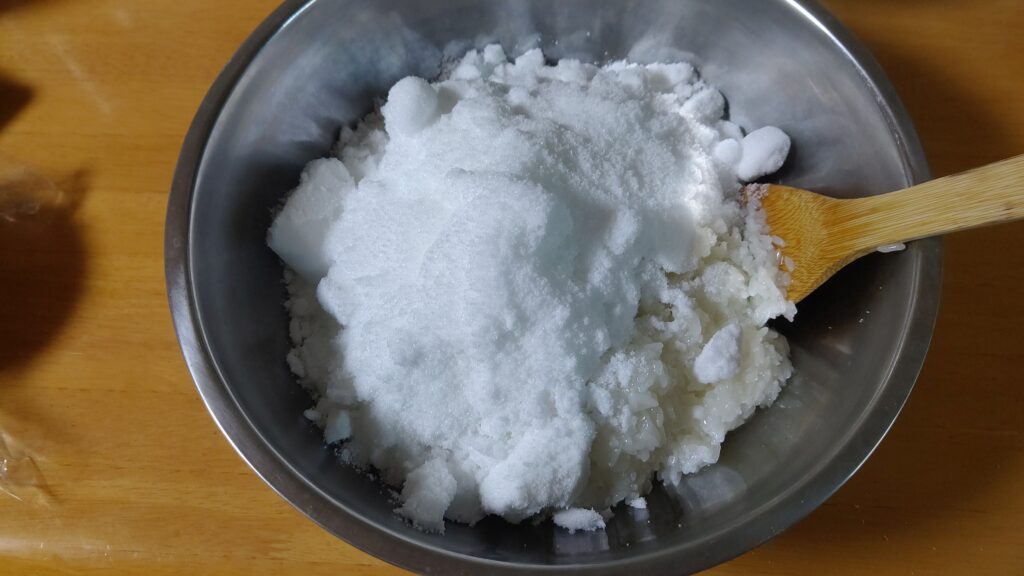
3.Prepare the eggplants: remove the stems, wash them, and pat dry with paper towels.
4.In a large bowl, sprinkle the eggplants with alum powder, gently mixing by hand to coat them evenly.
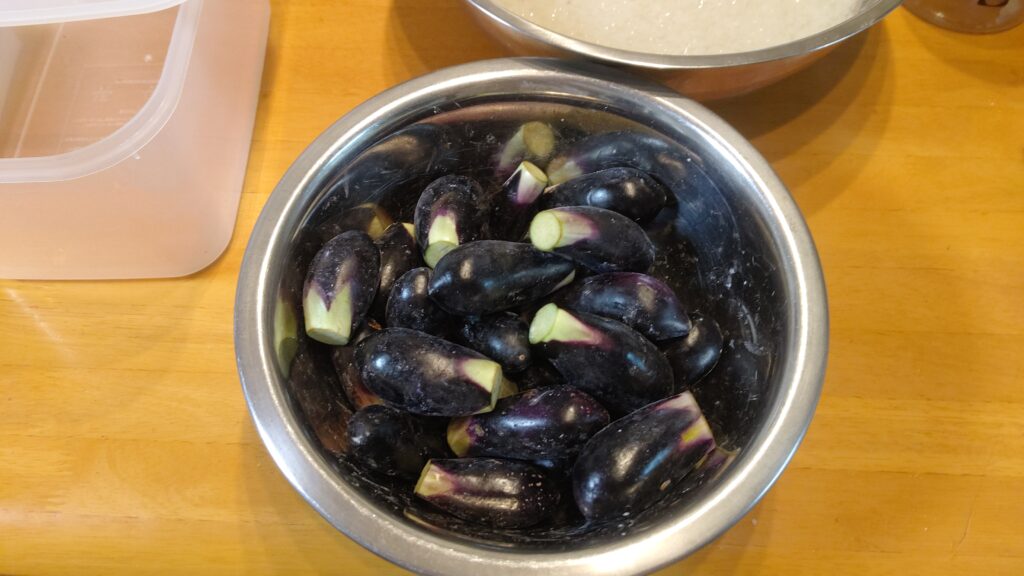
5.Place the eggplants in a deep container and pour the cooled rice mixture over them.
(Be sure the rice is no longer hot—heat can dull the eggplants’ vibrant color.)

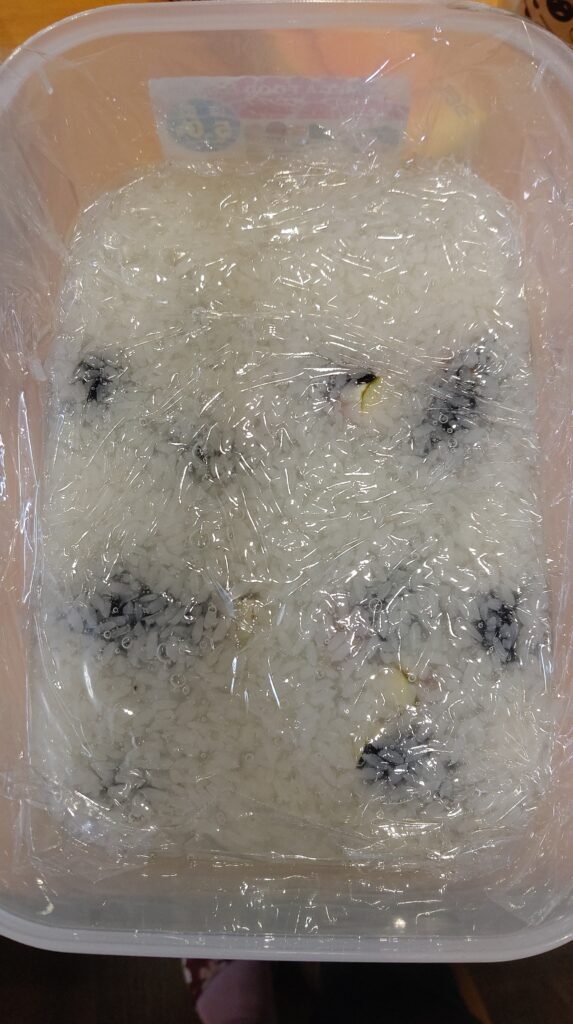
6.You might worry that the eggplants won’t be fully submerged,
but don’t worry—they’ll gradually float up and settle into the rice bed.
7.Cover with plastic wrap or foil, and place a small plate or weight on top.
After one day, they’re ready to eat.

🥢 Notes
- You can use this rice bed to pickle other vegetables too.
Try separating them into smaller containers by type. - The rice bed can be reused about twice.
If you don’t mind a slight tint from the eggplants, feel free to add new vegetables after the first batch.
🧊 A Summer Memory
I learned this method from my mother, watching her hands move with quiet confidence.
She never measured, just knew.
This year, I asked her to teach me—while she’s still well enough to guide me.
Now, when I open the lid and see the glossy eggplants resting in their rice bed, I feel her presence in the kitchen.
It’s not just a recipe. It’s a memory, preserved in sweetness.
🌍 Cultural Note for English Readers
In Japan, tsukedoko refers to the base used for pickling—each household has its own version.
Some use rice bran (nukadoko), others miso (misodoko), or sake lees (sakedoko).
Mochigome tsukedoko is less common, but deeply loved in some regions and families.
It’s not fermented, but gently infused.
A quiet method, rooted in care.


最近のコメント