

Datemaki is a sweet, rolled omelet traditionally enjoyed during the Japanese New Year.
Its spiral shape resembles ancient scrolls, which is why it symbolizes knowledge, learning, and academic success.

The bright golden color also adds a celebratory touch to osechi ryori, the special dishes prepared for New Year’s Day in Japan.
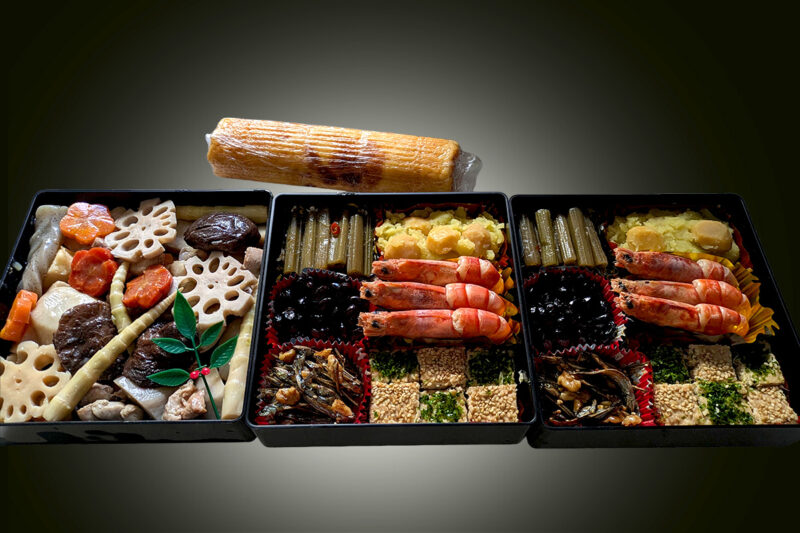
While datemaki is often sold pre-made, making it at home is surprisingly simple—and wonderfully delicious.
Below are two popular versions: a traditional white fish version and an easy hanpen version.
Both create a beautifully fluffy texture and bring a touch of Japanese New Year tradition to your table.
🎏 Two Ways to Make Datemaki
1. Traditional White Fish Version
This classic method uses white fish such as tilefish or cod.
It produces a rich, smooth flavor and a beautifully airy texture.
Ingredients
Eggs … 5
White fish fillet (tilefish or cod) … 120 g
【A】
Dashi … 1/2 cup
Sugar … 60 g
Mirin … 2 1/2 Tbsp
Soy sauce … 1 tsp
Salt … a pinch
Instructions
- Preheat the oven to 200°C (392°F).
- Crack the eggs into a bowl, add A, and roughly chop the fish into the bowl.
- Blend everything until completely smooth.
- Pour the mixture into a baking tray or heatproof container.
- Bake at 200°C (392°F) for 5 minutes, then reduce to 180°C (356°F) and bake for another 15 minutes.
- Flip the baked sheet onto a bamboo sushi mat (oni-sudare if available).
- Roll it tightly from the front, like a scroll.
- Secure with rubber bands and let it cool standing upright.
(Some liquid may seep out as it cools—place it on a tray.)
2. Easy Hanpen Version
This version uses hanpen, a soft Japanese fish cake, to create a light and fluffy texture with minimal effort.
What is Hanpen?
Hanpen is a soft, airy Japanese fish cake made from white fish and yam.
It blends smoothly and gives datemaki a wonderfully fluffy finish.
Where to Find It
You can often find hanpen at Japanese grocery stores or large Asian supermarkets.
If it’s not available in your area, simply use the white fish version above—it’s an excellent alternative.
Ingredients
Eggs … 5
Hanpen … 100 g
【A】
Dashi … 1/2 cup
Sugar … 2 Tbsp
Mirin … 1 Tbsp
Soy sauce … 1/2 tsp
Salt … a pinch
Instructions
- Preheat the oven to 210°C (410°F).
- Tear the hanpen into pieces and place in a blender.
- Add A and blend until smooth.
- Pour onto a baking sheet lined with parchment paper.
- Bake at 210°C (410°F) for 14 minutes.
- Place plastic wrap over a bamboo mat, lay the hot datemaki on top, and roll it tightly.
- Secure with rubber bands and let it rest for about 30 minutes.

Video reference:
🎍 The Meaning Behind Datemaki
Datemaki carries several symbolic meanings in Japanese culture:
Academic Success
Its rolled shape resembles ancient scrolls, representing knowledge, learning, and intellectual growth.
Elegance & Celebration
The word “date” can mean stylish or elegant, and the golden color adds a festive, luxurious touch.
Prosperity & Family Harmony
Because it’s made with eggs, datemaki also symbolizes fertility, prosperity, and a harmonious household.
In my own family, I always served datemaki when my children were preparing for exams.
This year, I’m rolling one for myself—layering knowledge, culture, and a bit of joy into each fold.

最近のコメント